Weather Forecast River Levels FB Twitter Instagram Pinterest

(208) 634-4303 | RIVERBEAT BLOG

SIX OR TWELVE DAY RIVER ADVENTURES

MIDDLE FORK AND MAIN SALMON RIVERS, IDAHO

Category Archive: Idaho RIver Rafting

  1. The Interior Guide: How to Actually Show Up for Yourself this River Trip

    Comments Off on The Interior Guide: How to Actually Show Up for Yourself this River Trip
    Yep, the world feels intensely chaotic right now. Most of us arrive at the put-in carrying a “digital body”—shoulders tight, nervous system buzzing from the pings and dings of the next alarm clock or obligatory call. The news is out, and we know what’s good for us. That being said, the meditation app still remains unopened on your phone and the Instagram daily limit has been disregarded. Oh well, it’s hard to reset when the clatter and chatter continues steady on. Sometimes we need a source grander than our own dominion. The river is like a soulful mama, she knows what is good for you. As we come to her currents, a rushing lullaby to remind our calm and compassion to come out of the corner. Call your mama and come home. 

    The river can be the loving mother we all need right now, naturally wired to scoop you up and rock you back to baseline.

    Step 1: First, let her canyon walls draw your eyes upward. Shifting into a panoramic gaze allows your optic nerves to signal the brainstem to activate the parasympathetic nervous system, effectively turning off your fight-or-flight response and triggering an involuntary release of muscular tension. Lean in, the canyon walls encourage, “Baby drop that heavy, land-locked baggage you’re lugging around that simply doesn’t float”

    Step 2: Next darling, come to the water. A deliberate dunk in her icy currents initiates a biological hard reset, stimulating the vagus nerve to instantly cut the stress loop you’ve been stuck in since last Tuesday’s email thread. She’s washing the static right off of you.

    Step 3: As we drift downstream, pay attention to the life thriving in her margins. Watch an osprey track the currents from an old Ponderosa snag, or notice how the mountain mahogany clings to sheer granite walls with quiet, rooted resilience. Mama Salmon doesn’t rush growth. She simply provides the space to adapt to her tough love, showing you firsthand how to stay anchored when the current turns rough.

    Step 4: Finally, use the timeouts she builds for you. An eddy is just water pulling over to the side of the road, on a long road trip with three toddlers in the back seat, to catch its breath. When we hit those glassy, flat stretches, let her hold the silence.

    Don’t overthink it—you do enough of that back home. Childlike fun and simple curiosity are the ultimate catalysts for transformation out here. The river is already reaching out with open arms to help you regulate. Your only job is to let go and let Mama hold you.
     

  2. Internal Hydrology: Why You’re More Watershed Than Human

    Comments Off on Internal Hydrology: Why You’re More Watershed Than Human

    By Elle Olsztyn

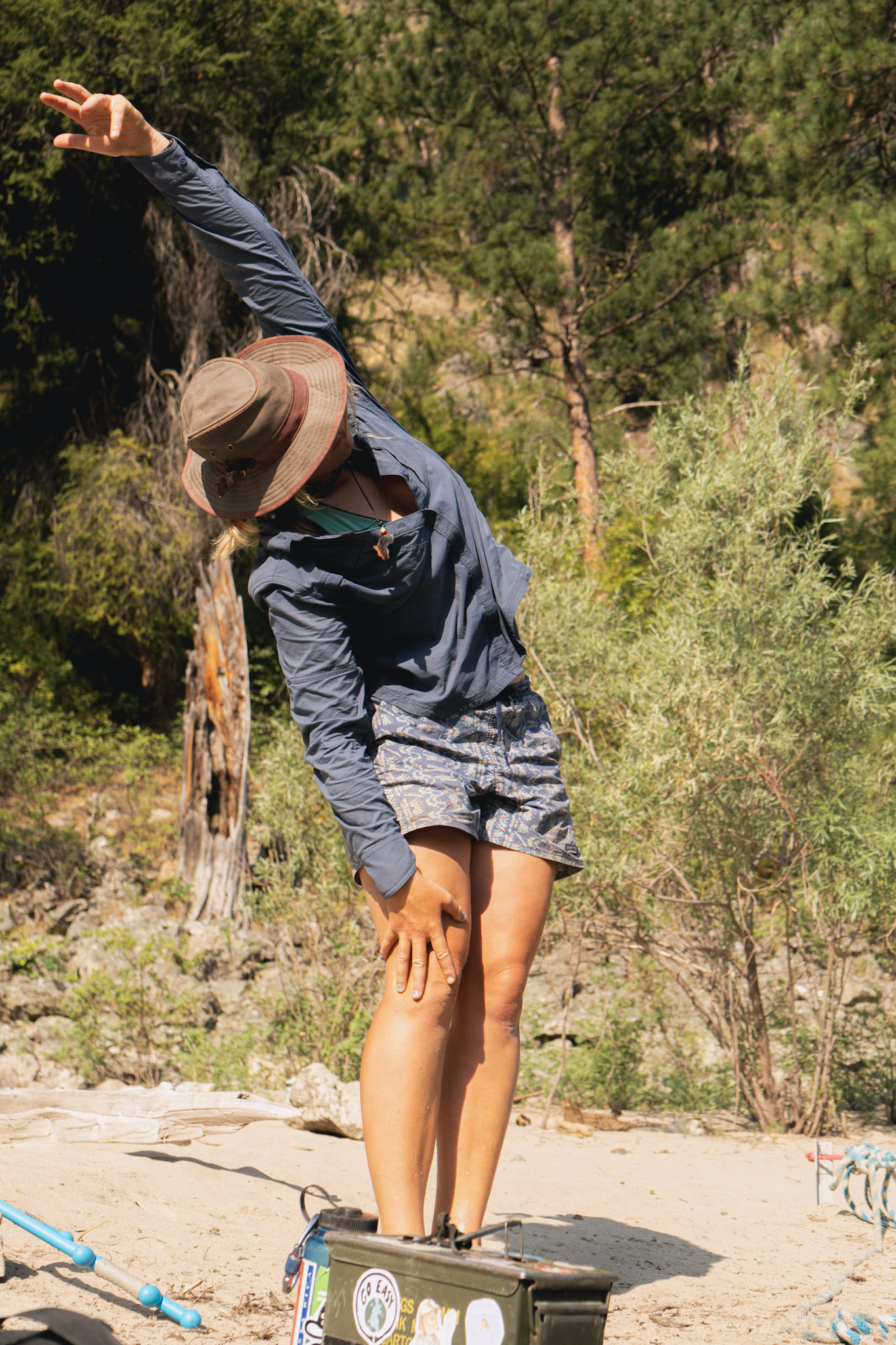
    Elle OlsztynIn yoga, we speak of Nadis—the thousands of invisible channels through which Prana (life force) pulses. But you don’t need a yoga mat to visualize them. If you look at a river system from an aerial view, a diagram of the Earth’s circulatory system appears. Our bodies are 60% water; our veins, nerves, and energy channels follow a similar braided cartography as a free-flowing river.

    But here’s the thing: It isn’t until you spend six days on the Salmon River—feeling into the current’s rhythmic lullaby or weighted pull of the oars—that you realize you aren’t just traveling through a watershed. You are one.

    As a lover of movement and the ancestral wisdom of our own physiology, I’ve been recently traveling the world exploring traditional teachings that reconnect us to our restorative nature. Through these travels, my relationship to river guiding continues to evolve. I’ve realized that the “dams” we encounter in rivers—stagnation, blockages, and rigid walls—mirror the ones we build inside our own bodies. When we understand a little about our own Internal Hydrology, we can trade “muscling” our way through life for the fluid, restorative power of the current.

    The Thalweg: The Spine as the Central Channel

    In hydrology, the Main Channel is the heart of the system. It’s the primary river vein that dictates the health of every tributary and eddy downstream. Within the Frank Church-River of No Return Wilderness, the Main Salmon River surges through a deep canyon. Amidst the center of that current is the Thalweg, where the water is calmest and most powerful. However, if this main channel becomes blocked, the entire ecosystem stalls.

    In your body, that Main Channel is your spine—but more specifically, it is your internal Thalweg.

    In the yogic tradition, this is the Sushumna Nadi. Physically, it corresponds to your central nervous system and is the primary current through which your life force flows from tailbone to crown. Just as a river guide inspects the current to find that one line of maximum efficiency and depth, we can explore such current in own bodies.

    Alignment vs. Stagnation

    Drawing from the work of my teacher, Simon Borg-Olivier, and his Yoga Synergy system, I’ve learned that “the banks” (our bones and alignment) determine the health of the “current” (our blood and energy).

    eMost of us have become “Modern-Day Statue People”—accustomed to chairs, we either sit with lower backs cemented like a concrete dam or slump like a collapsing cutbank. But a rigid or collapsed spine is a dammed river. It creates a logjam of tension in your neck and shoulders and blocks the flow of information through your nerves. In contrast, when this channel is free-flowing, your reactions are faster, your breath slower, and your nervous system is resilient enough to navigate the big water and “Redside” rapids of life without snapping.

    Micro-Ritual: Become the Watershed

    On your next river trip, I invite you to explore the living ecosystem that is YOU. While sitting on the raft or in your kayak, notice the way the river’s current ungulates and swirls. When the water turns glassy, try this:

    • The Spinal Ripple: Instead of sitting like a statue, imagine a gentle ripple moving from your tailbone to the crown of your head.
    • The Riffle Sync: Synchronize your wiggling toes and waving fingers to the riffles in the current. Imagine the blood reaching the furthest “tributaries” of your extremities.
    • Find Extension: Imagine a small wave moving through your vertebrae. Can you find a little more space? A little more extension?

    By bringing this gentle consciousness to your eyes, jaw, and shoulders, we practice a state of fluid presence. This is where your body finally begins to process and flush the stress you carried with you from the outer world.

    Softening your spine doesn’t mean losing your strength; it means finding the same kind of power a river has—power that comes from momentum and structure, not from being a wall.

  3. Blogs are Reflections from a Salmon River SUP Adventure

    Comments Off on Blogs are Reflections from a Salmon River SUP Adventure

    Last fall, my wife, Toria, and I completed the first known self-support stand up paddleboard descent of the entire Salmon River. We launched from Stanley on October 3rd. 398 miles later, on October 27, we made it to Heller Bar on the Snake River. The journey was an incredible adventure, and definitely one of the best months of my life. There’s something about being outside, away from your daily life, that allows you to take a step back and reflect on what you are doing. Here are a few of my reflections from a month spent on the Salmon River:

    The Salmon River is worth fighting for. I’ve long known the Salmon River was special but seeing it from its start to finish made me fall even more in love with it. River protection is an ongoing fight- and one that is worth fighting.

    You can find and build routine anywhere. 2025 was an incredible year for me but one that lacked a lot of routine. The last place I thought I would find routine was on a fall whitewater SUP expedition and yet, there it was! It was a much needed lesson that just because each week doesn’t look the same doesn’t mean that good routines can’t be developed.

    The vast majority of people in the world are friendly and want the best for others. When we pushed off of the shore in Stanley, I was prepared for a month of minimal social interaction with anyone except for Toria. I was so wrong! We interacted with people all over: from steelheaders along the river corridor, to miners in bars, to van lifers in gas stations, to e-bikers in hot springs. Almost every person that we met was kind to us and many offered to try to help us in various ways, from offering rides, materials, or their homes. It was a much needed reminder that most people in the world are overwhelmingly good, even when people try to make us feel divided.

    Sleep is good. Sleep has never been a forte of mine but it turns out when you paddle all day and it gets dark and cold early that getting into your sleeping bag is really nice! I slept more on our trip than I think I have in my whole adult life and it was awesome.

    The SUP is actually a really great expedition craft. People were always stunned that we were able to carry everything that we needed on our SUPs. And while it wasn’t quite as deluxe as a rafting trip we definitely carried luxuries such as cheese, multiple stoves, my Surfer’s Journal magazine, and the things to make a chocolate olive oil cake. The weight on the boards actually made it easier to punch through big rapids and we were able to maneuver well through all of the exposed rocks in the low water.

    It takes a long time to develop the skills to pull off something big. Five years ago, I was totally unprepared to do this trip. And while lots of people still thought what we did was pretty out there, it felt totally within the realm of what we were capable of. There were lots of skills that went into it, from running whitewater, to trip planning for a long expedition, to outdoor cooking, to staying warm in cold conditions, to gear repair and more. If you’ve got a trip that you dream about doing but aren’t capable of doing yet, keep working on all of the different parts of it. Someday you’ll be able to make it happen!

  4. Threats to the Salmon River – Stibnite Mine

    Comments Off on Threats to the Salmon River – Stibnite Mine

    The Salmon River has been special to me ever since my first trip down it in 2013. There is something magical about every single run I’ve taken down it. I’ve always felt compelled to help protect it- it’s one of the main reasons I love river guiding. I feel like when we are able to share the river with others they often become stewards and guardians of it. But on this trip I felt both an urgency and an outrage about the river that I had never felt so strongly before.

    While there are lots of threats to the river, the one that I have thought about the most since our trip is the Stibnite Gold Mine (SGM) project on the South Fork of the Salmon River. The SGM is an open-pit gold, silver, and antimony mine along with an ore-processing facility. Perpetua Resources, the gold mining company behind this project, says that this project will provide antimony to the U.S. military. While antimony is a key mineral for a range of military products, Perpetua Resources themselves have admitted that only around 10% of the antimony mined at the SGM will be headed to the military due to the lower grade antimony present at the site. Other mining projects in the western U.S. contain higher grade antimony that the military can more easily use.

    In many ways, the presence of antimony at the SGM site is what is allowing Perpetua Resources to push forward with its main goal: mining gold. Jon Cherry, the CEO of Perpetua Resources, recently said on the podcast Mining Stock Daily that “Antimony is the enabler because of the government’s support. The economics are driven all by the gold. Our mine plan is based on gold.” While I do think that lots of people could be convinced that the mining of antimony is important for national security, it’s hard to imagine many people being willing to permanently damage public land and water so that investors in a gold mining company to get rich. To add insult to injury, the Mining Law of 1872 (yup, we still use that) exempts companies from paying royalties on gold mined from public lands. So while the government receives a some money when things such as oil and gas are mined on public lands, there would be no royalties on the predicted $18 billion of gold that would come out of the ground.

    In the best case scenario, the SGM would wreak havoc on public lands, waters, and health. The proposed project would destroy over 20% of critical habitat for threatened chinook salmon and bull trout in the project area. The water temperature is also projected to rise to lethal levels for these fish. The project also violates Indigenous treaty rights and would permanently scar thousands of acres of public land in the headwaters of the South Fork of the Salmon River. Contamination of the water from arsenic, mercury and other heavy metals would also likely occur.

    In a worst case scenario with a spill, water contaminated with cyanide and other pollutants would flow downriver, onto the Main Salmon, Snake, and Columbia Rivers. The risk of a spill in open-pit cyanide leach mining is so real that the practice has been banned in neighboring Montana since 1998.

    In the end, river conservation isn’t something that we will someday just achieve. These special places will likely need us to keep advocating for them in perpetuity. And while we definitely need mines here in the U.S., it doesn’t mean that every mine is the right mine. While the public comment period for the Stibnite Gold Mine project is currently closed, there are lots of organizations continuing to work to stop this project through other methods. The list below is in no way exhaustive- these are just some of the organizations that I know that are working on this project. If you feel passionate about the Salmon River, please consider donating to one of these organizations so that they can continue fighting to protect this place that we love.

    Idaho Conservation League

    Idaho Rivers United

    Save the South Fork Salmon

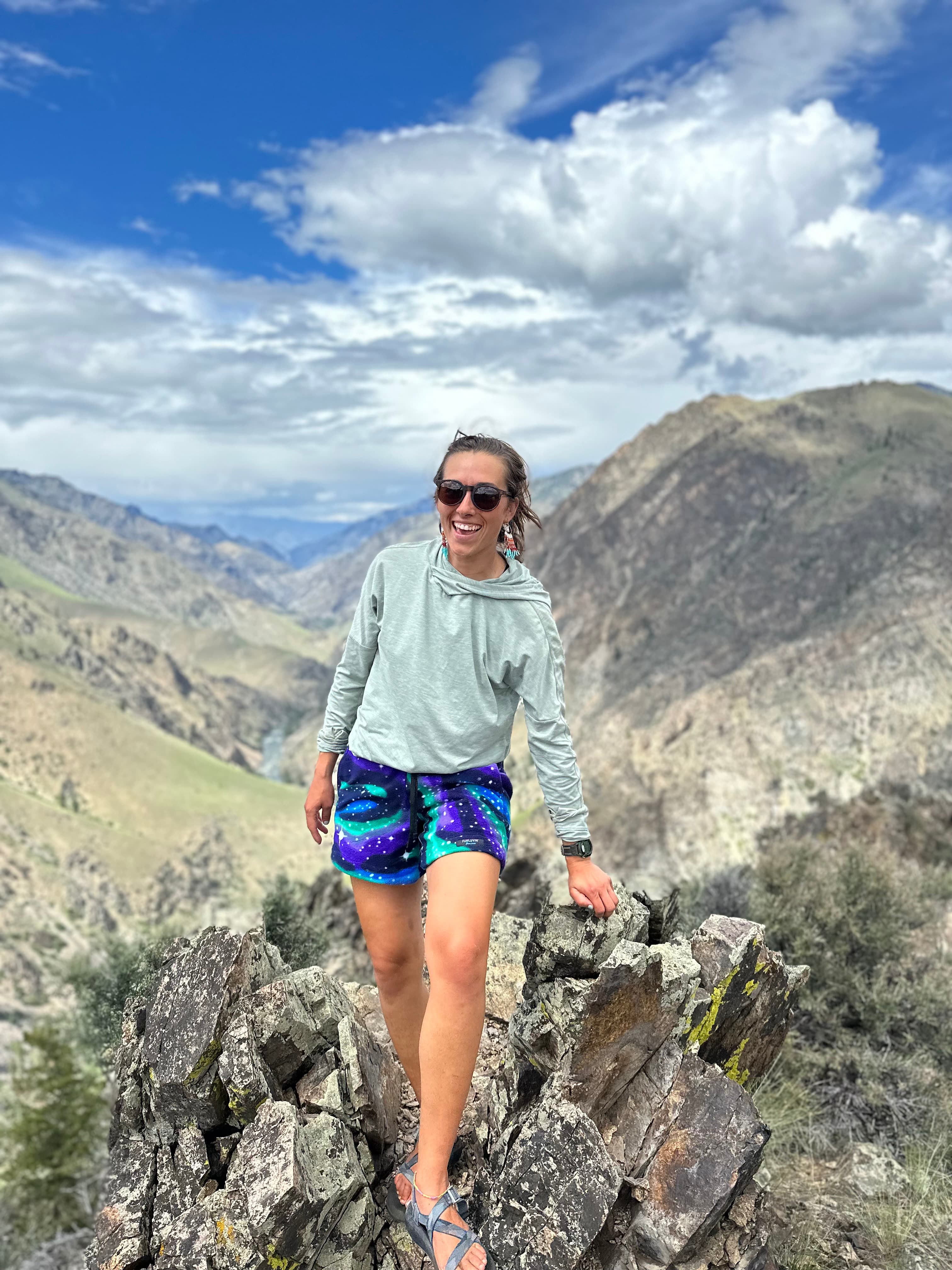
  5. Off Beat Interview Series with Olivia

    Comments Off on Off Beat Interview Series with Olivia

    Tell us a little about yourself! Where did you grow up?

    OThis is always such a hard question for me. I lived in Reno, NV until I was six years old and after that my family moved every year. I can’t even pick a region as we lived in the east, the middle and the west of the U.S. My family was pretty uprooted and We found home in each other.

    How did you find your way to the river?

    I moved to McCall when I was 19 years old and made friends who took me rafting on the day stretch in Riggins. My first time rafting was also my first experience in a hardshell kayak. It was exhilarating; when I flipped upside down, I struggled to find my pull tab, panicked, and ended up kicking myself out of the kayak. When I resurfaced and was pulled into the nearby raft, I felt a deep love for the river and this overwhelming feeling of belonging.

    A few months later, I was called back home—at the time, Berkeley, CA—because my mom had been diagnosed with colon cancer. I wanted to be with her as she navigated the early stages of her illness. I quickly realized I needed an outlet for my physical and emotional energy, so on weekends, I drove three hours from Berkeley to Coloma to volunteer with a non-profit rafting company offering adaptive whitewater adventures. To volunteer, I needed to attend guide school, so the South Fork of the American River became the place where I learned to paddle, guide and read water.

    Several months later, I moved back to Idaho and fell deeply in love with the Salmon River, where I learned to kayak, row boats, and connect with water. It was also on a sandy beach of the Salmon where I married my now-husband. I feel incredibly lucky and grateful to spend time in, on, and with the magnificent Salmon River.

    If you could be a river super hero, what would you be?

    If I could be a river super hero, I would be ‘Fierce Forager’. She has kevlar skin and knows information about every mushroom she comes across.

    What is your favorite dress up theme?

    I LOVE to dress up! It is so hard to pick a theme and honestly I am at my best when I just layer my entire costume box onto myself but for the sake of the question I’ll say Drag Disco Inferno!

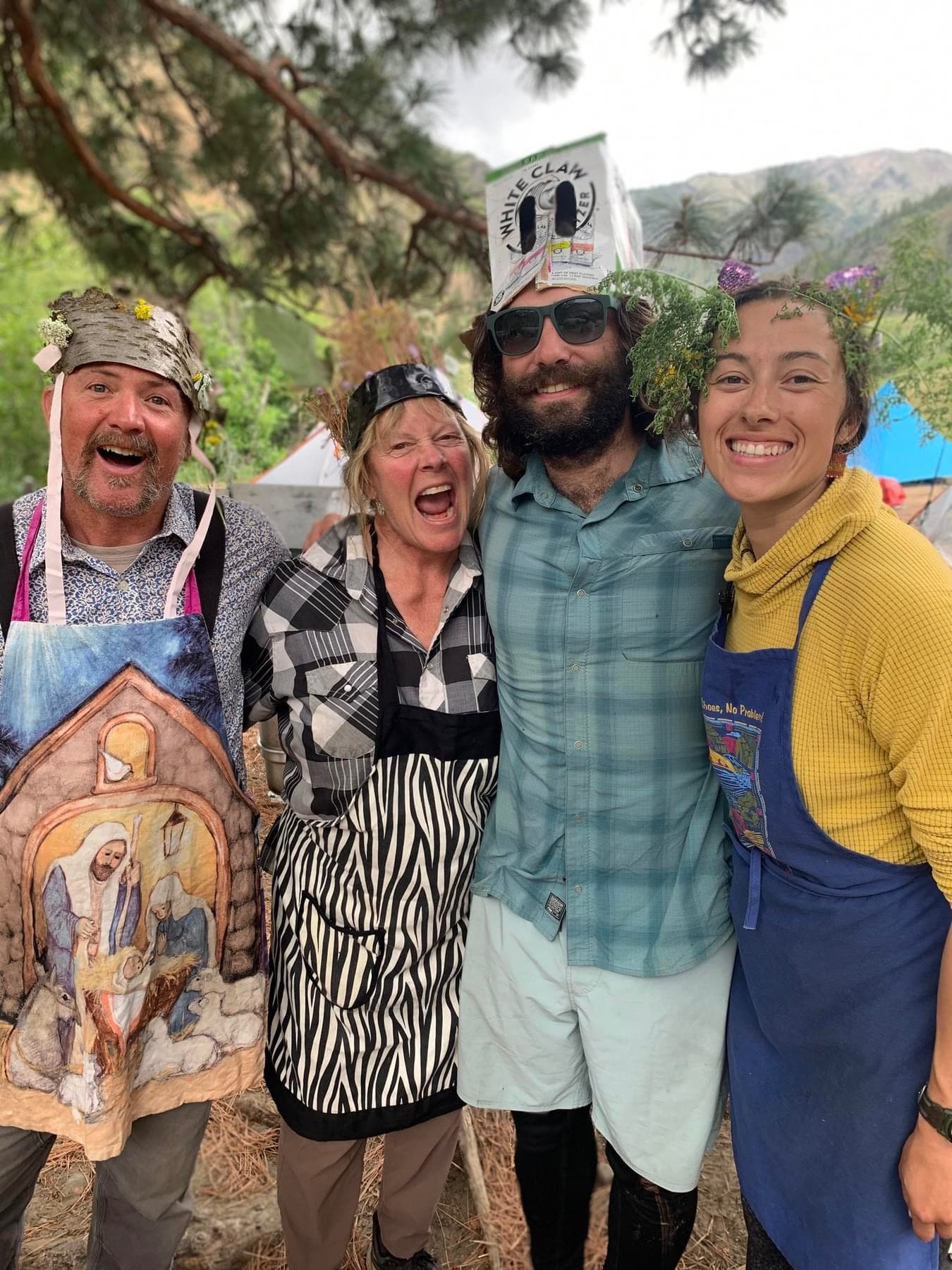
    What is your ‘go to’ crazy hat night creation?

    I have never had a crazy hat night but it sounds fun! If this is a river tradition then I can see myself weaving natural items into a beer box so that they stick out at the top, then I would stake one or two beer cans onto a couple sticks that I fastened to the box, I would secure this to my head using webbing or some bandanas.

    What brought you to Canyons?

    I told my husband last year that if Canyons didn’t hire me I would stop guiding. He might have enjoyed a bit of the latter but here I am! Canyons attracted me because of its loving, inclusive culture where people are celebrated for who they are! Canyons is also a company that stewards the places we work and play by moving and acting intentionally. So far I have guided one trip with Canyons and all I can say is it feels like home.

    How many years have you worked here?

    I guided one trip in 2025 so 2026 will be my first full season working for Canyons!

    What is your favorite thing about Canyons?

    My favorite thing about Canyons is the feeling I get when I am in the shop looking at the wall of pictures in the office.

    If you could describe Canyons in 3 words?

    Rainbow ducky adventure

    When you hear the word Idaho, what comes to mind?

    Wilderness, solitude, water

    What are your top three favorite camps?

    Indian Creek on the Main salmon, Marble Creek Right on the Middle, Cradle on the Middle

    Your favorite hike?

    I love hiking to the yew grove from Indian creek.

    Top three favorite rapids?

    Devil’s tooth at low water, Cramer, Rubber. I am just listing rapids that are vivid in my memory. I think this might change as I spend more time on these rivers.

    Currently what is your nemesis rapid?

    Powerhouse if you can believe it! I swam there in october and ripped my gasket so I had to wrap my wrist in duct tape every morning for 6 days.

    What river do you want to run that you haven’t yet?

    The list is huge but I’ll say The Grand Canyon for starters

    What do you consider a ‘real’ job?

    A ‘real’ job is one that you get paid to do. I like to keep it real at my jobs by forming connections with the people and places around me.

    If you could only have one kayak in your quiver, what would it be and why?

    It would be my jackson all star. Simply because I already own it and out of all of my boats it challenges me the most. Plus I love to surf peace wave and it is a very fun boat on that wave.

    What is your favorite thing to cook on the river?

    Any dutch oven dessert

    If you could take a musician or band down the river today, who would it be?

    Regina Spektor or Fred Armisen because he would find a way to bring his drums and it would be hilarious.

    What is your most memorable swim in a river?

    I swam twice a few years ago when I was kayaking the outlet of upper payette lake. It is a moving creek with rocks and logs everywhere and I wasn’t ready for the continuous nature of it but boy did I think I had it. I swam once and it was b-u-m-p-y, I was feeling a little banged up on my bum but I felt ready to get back in my boat. I got back in my boat and got pushed on this rock that was sticking out of the water. I could tell I was going over so I stupidly threw my paddle and tried to push off of the rock so it would let me go. I went upside down, swam, hit a ton of rocks and then made it to shore with my boat. My buddy and my husband tag teamed the rescue and my boat was pulled to shore but the nose was totally punched in. Boiling water fixed it but I hold that swim vividly in my memory because I really thought I was going to get hung up in a strainer and drown and I was incredibly humbled.

    What is one of your river rituals or superstitions?

    Remember to look up!

    What is your most valued non river related item that you bring with you on every trip?

    Cotton socks

    What is your favorite groover spot?

    Anywhere, say good morning to down river traffic. I do really like the groover spot at California though and you can’t wave to the river from there…

  6. Daisy Tappan: An Inspiration and Example

    Comments Off on Daisy Tappan: An Inspiration and Example

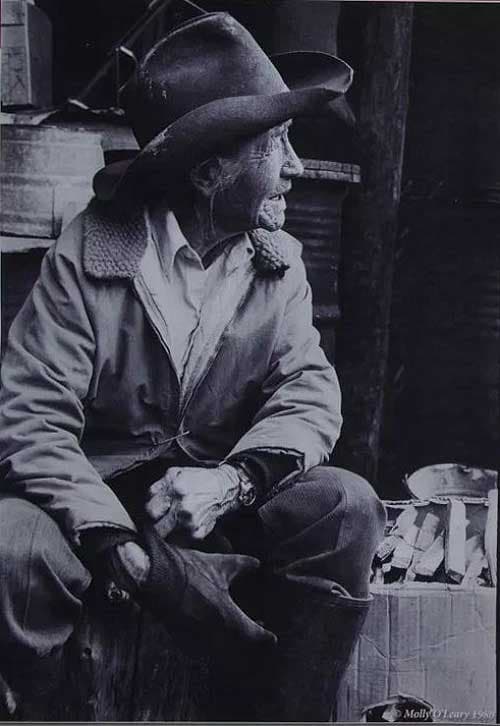
    Daisy Tappan: An Inspiration and ExampleDaisy Erma Paulsen Tappan (1908-1984) is a fabulous example of an impressive person who simply happened to be a woman. There are tales of her chasing off bears who tried to eat her orchard and rolling cigarettes one-handed. When she and her husband got pushed off Tappan Ranch at Grouse Creek on the Middle Fork of the Salmon, she became one of the two year-round mail deliverers out of Yellow Pine. She ran a dogsled, hauling her kids and mail all around some of Idaho’s most rugged and frigid country.And it seems, she still knew a good time when she saw one. Daisy Tappan would take her two boys over 40 miles upstream to Sheepeater Hot Springs so they could splash around in a pool made by some industrious beavers. Where did she find the time?One of the many things I love about being out in the Salmon river drainage is how little biological sex matters out there. Obviously, some of us care a lot, but in the end, what we’re capable of takes the cake. As river guides, can we catch an eddy? Can we cook your dinner before the sun goes down? Can we right a flipped raft? Can we save an errant ducky or woo a rattlesnake out of camp? It’s so apparent that that is what really matters. Daisy Tappan got it, and thank goodness we do, too.

    Written by: Auri East
    Source: The Yellow Pine Times

  7. Composting with Canyons

    Comments Off on Composting with Canyons

    There are a lot of things that I love about working for Canyons. There are the people that I get to work with. There is the “office,” the Salmon River nestled in the Frank Church River of No Return Wilderness. There are the guests that I get to meet who bring great stories, new perspectives, and warmth. The food, the views.. I could go on and on. But there is a non-obvious part of working for Canyons that I love. And that is the fact that we compost as we float downriver!

    You may or may not have noticed the 5 gallon buckets that join us for the trip but week after week, they are there, quietly collecting food waste. So, where do all of those food scraps go? Directly into the garden of our transportation director, Alex! In his garden he grows everything from tomatoes to peppers to carrots and more.

    The compost even makes it full circle. If you’ve ever enjoyed our baked brie with jam, you’ve eaten something from Alex’s garden, nourished with compost from a previous Canyons trip!

    You might think, okay that sounds really nice, but what is the big deal? It’s a huge one actually! As food decomposes in a landfill, it does so without oxygen. This process releases methane gas, a greenhouse gas that traps heat in the atmosphere about 25 times more than does carbon dioxide. When food waste is composted, it converts the food waste into stable carbon within the soil. If you’re looking to take a bit of the Canyons river energy home with you, consider finding a way to compost at home!

  8. Off Beat Interview Series with Kami

    Comments Off on Off Beat Interview Series with Kami

    Off Beat Interview Series with Kami

    Riverbeat Questions

    Tell us a little about yourself! Where did you grow up?

    I grew up in the flatlands of Minnesota, in a small town called Randolph

    How did you find your way to the river?

    I grew up with a river flowing through my backyard (truly, literally in my backyard) and

    spent most of my days on a little grassy beach on that river, inevitably falling in love with

    flowing rivers. But it wasn’t until 2020, which is where I was introduced to the river

    rafting scene in Moab, Utah. I started working for a nonprofit called Canyonlands Field

    Institute, where I was able to combine outdoor education and multi-day river trips in the

    southwest rivers and canyons. And then made my way to Idaho to guide on free-flowing

    rivers, which is a dream and one of the highest privileges.

    If you could be a river super hero, what would you be?

    Ooooohhh, to be honest…. I kind of already know her. Her name is Kamalamadingdong

    and she appears once in a blue moon on a Canyons trip. She’s a glorious diva that will be

    sure to bring the house down. Hopefully someday you’ll be lucky enough to meet her…

    (iykyk).

    What is your favorite dress up theme?

    My favorite dress up theme is anything to do with sparkles, glitter and tutus.

    What is your ‘go to’ crazy hat night creation?

    I like to have my creation be things in nature that have already moved past their time or

    are moreso not alive, maybe fallen leaves, sticks, rocks, decayed flowers or sometimes

    even bones and skulls! The hard part is finding a vessel to hold them all, but sometimes

    I’ll just stick them all in my hair!

    What brought you to Canyons?

    I knew that if I wanted to keep guiding I wanted to be with an outfitter that felt

    intentional and purposeful with why they existed on the river. I wanted to align with

    their values and feel that they were proud to be inclusive, stewards, silly and passionate

    about the river and the landscape we get to traverse on. I found Canyons, had a phone

    call with Greg, went on the training trip and the rest was history. I was in love.

    How many years have you worked here?

    I’m coming up on my 3rd season!

    What is your favorite thing about Canyons?

    It’s hard not to say everything. I think my absolute favorite thing is how much I feel like

    the Canyons team is my chosen family. I feel celebrated and held and pushed to grow.

    They allow me to be silly and passionate in the work that I do and ultimately, I want

    people to feel as loved by Canyons as I do.

    If you could describe Canyons in 3 words?

    Flare, magical, top-notch

    When you hear the word Idaho, what comes to mind?

    Wild, formidable, staggering

    What are your top three favorite camps?

    Cradle and Shelf on the Middle, California on the Main

    Your favorite hike?

    Ohhh I love to trail run / hike to Loon Hot springs (or past loon hot springs!!!)

    Top three favorite rapids?

    Weber, Cramer, and Big Mallard

    Currently what is your nemesis rapid?

    Always Chittam rapid.

    What river do you want to run that you haven’t yet?

    So many! I’d love to run

    What do you consider a ‘real’ job?

    A real job is any job that you are paid to do, I strongly dislike the hierarchy of jobs or

    careers. We all make the world go round and anything that provides a paycheck is a real

    job, there isn’t anything imaginary about that.

    Going at ‘real’ in a different sense, I think being in these landscapes and on these rivers

    is as real as it will ever get. It’s the realest connection, feeling and experience I’ve ever

    had. Life feels REAL out there.

    If you could only have one kayak in your quiver, what would it be and why?

    Being newer to the kayaking scene, there are only a few I’ve experienced, but I do love

    the Dagger Rewind.

    What is your favorite thing to cook on the river?

    I love breakfast made to order! It’s fun getting to talk to everyone in the morning and

    also make something different with each person!

    If you could take a musician or band down the river today, who would it be?

    I would love to take Nick Shoulders, I think he would be a hoot and a holler. OR Maggie

    Rogers, because of course.

    What is your most memorable swim in a river?

    Most of them have been on the Salmon! My most memorable swim was also my very

    first swim, which was Chittam rapid on the Main Salmon at 32,000 cfs. It was before my

    time at Canyons, but it was my first time on the Main Salmon and I was rowing a gear

    boat, no guests. I had lost an oar, went sideways to the perfectly timed wave that I

    thought was going to flip my boat, but just washed me out of the boat. I got sucked into a

    whirlpool, touched the bottom of the river and resurfaced, only to get sucked down

    again. It was gnarly.

    What is one of your river rituals or superstitions?

    Before launching each day, I touch the water and give gratitude towards the water and

    the canyon (and also ask for safe passage). Another is I must be wearing dangly earrings.

    If I’m not wearing any, I’m asking for trouble.

    What is your most valued non river related item that you bring with you on

    every trip?

    Oh man, I feel like I have a few of these. Probably tiger balm or glitter. OR floss.

    What is your favorite groover spot?

    Big fan of the groover spot at Ship Island

  9. Snake River Dams Update

    Comments Off on Snake River Dams Update

    Author: Ian Connolly

    I would not be doing my due diligence if I failed to share with you all the latest updates from the fight to remove the four lower Snake River dams. I will start at the beginning, in case any readers of you are new to this story or just in need of a refresher.

    Background on Salmon and the Snake River dams

    On the Pacific Coast of North America, six species of salmon make their migrations from rivers to the sea and back to the rivers where they were born. These anadromous fish are keystone species, meaning their presence sustains the life of entire ecosystems. They contribute to ecosystems with the nutrition that they provide to other species, including to bears, eagles, trees, humans, and many more. Salmon are deeply significant to all life on the Pacific coast, especially to indigenous peoples. Amazingly, salmon also return (previously in abundance) all the way from the West Coast to Idaho.

    The Columbia River is the largest river in the Northwest, running more than 1,200 miles from British Columbia to its terminus on the Oregon/Washington coast. Prior to the arrival of Europeans in North America, the Columbia hosted up to an estimated 12 million salmon per year. Now, the Columbia returns a fraction of that number of salmon, a decline that resulted in widespread “endangered” listings for salmon species beginning in the early 1990s. The causes of this decline are multiple: nineteen hydroelectric dams on the mainstem of the columbia, a legacy of overfishing, the decimation of indigenous peoples, and loss of critical habitat, among others.

    Despite the dire situation that salmon face, these remarkable species persist, and thanks to the conservation efforts of their dedicated advocates and tribal knowledge, wild salmon still have a chance.

    Among the best, most accessible salmon spawning habitat remaining in the Columbia Basin is in central Idaho in the Salmon and Clearwater rivers, nearly 1,000 miles from the coast of Oregon. There, the Frank Church wilderness, the largest in the lower 48, has preserved the spawning grounds of wild salmon.

    The Problem and the Solution

    Salmon biologists and tribal fish managers have spent years mapping out the potential paths to Salmon recovery, and the consensus is clear: if wild salmon could safely reach Idaho’s habitat in sufficient numbers (a 2% return rate would suffice) their populations could begin to climb again. The problem? Four dams on the lower Snake River that impede both downstream and upstream fish passage.

    Tribes and environmental organizations have pursued a multi-pronged strategy to attempt to recover salmon in the Columbia River. This strategy has included litigation, coalition building, public messaging, policymaking, and collaboration. Each of these strategies has been in part successful, but things are shifting in the American political landscape that threaten to relegate salmon to a fate of extinction. Though many voters were entirely unaware of it, the future of wild salmon was on the ballot last November, and we all know the outcome. To put it plainly, the Trump administration doesn’t care a lick about wild salmon, protecting wild places, or finding common sense solutions to these particular complex problems. Which puts us in a really bad position. But it is because of this grim outlook that we need all hands on deck.

    Recent Developments in the Fight to Save Salmon

    The long and short of it is that the Biden administration, for all of its faults, recruited staff members that cared a whole lot about Tribal sovereignty, solving the energy crisis, and saving wild salmon. I have been lucky enough to meet some of those folks and can tell you that real, genuine people from the West were brought into the decision-making spaces and effectively persuaded people in Washington to care. The president of the United States was briefed on wild salmon, and the connection to tribal sovereignty, and decided to send people into that arena to solve these problems. It is not hyperbole to say that the Biden administration was the best administration we have had in our lifetimes when it comes to tribal issues (of which wild salmon is one) and climate change (of which wild salmon is also one).

    A lot of developments happened during the Biden administration, but the most significant was an agreement between “the six sovereigns”  to develop a strategy for removing the four lower Snake River dams and funding energy replacement projects, primarily as a form of Tribal economic stimulus. This agreement is technically still in place, though it seems like it will fall apart in one way or another. Should this happen, the issue will return to the federal courts.

    Outside of the federal government, the folks driving the work to save wild salmon are all either working for Tribal governments, state governments, or non-profits (there is no meaningful push from the private sector to solve this problem because the private sector cares solely about generating profits). Now is the time to pitch in by learning the issues, running for local government or supporting elected officials who support salmon, and by donating to non-profits.

    The fate of wild salmon still rests in the balance, and within the tangled mess of politics in this country, salmon can and should serve as common ground. Ultimately,  the executive branch (the president) and the federal courts lack the authority to authorize the removal of the four lower Snake River dams. Only Congress can order their removal, and ultimately, that is where we come in. Congress is inherently designed to be responsive to the people of the United States and our only hope is to convince enough Congress-members to care. We have one, a republican house member from Idaho named Mike Simpson. But we need more – representatives who care, and more citizens who understand what is at stake. If we can come together, we can save wild salmon, it’s that simple.

    List of organizations to follow and support:

    • Nimiipuu Protecting the Environment: https://www.nimiipuuprotecting.org/home-original
    • Columbia Snake River Campaign: https://columbiasnakeriver.com/
    • Idaho Conservation League: https://idahoconservation.org/our-work/salmon-and-steelhead/
    • Idaho Rivers United: https://www.idahorivers.org/lsrd
    • Trout Unlimited: https://www.tu.org/lowersnake/
    • Save our Wild Salmon: https://www.wildsalmon.org/
    • Advocates for the West: https://advocateswest.org/protecting-fish-wildlife/
    • Save the Southfork: https://savethesouthforksalmon.com/
    • American Rivers: https://www.americanrivers.org/river/snake-river/
    • River Newe: https://rivernewe.org/
    • The Grand Salmon: https://salmonsourcetosea.com/meet-the-team/