


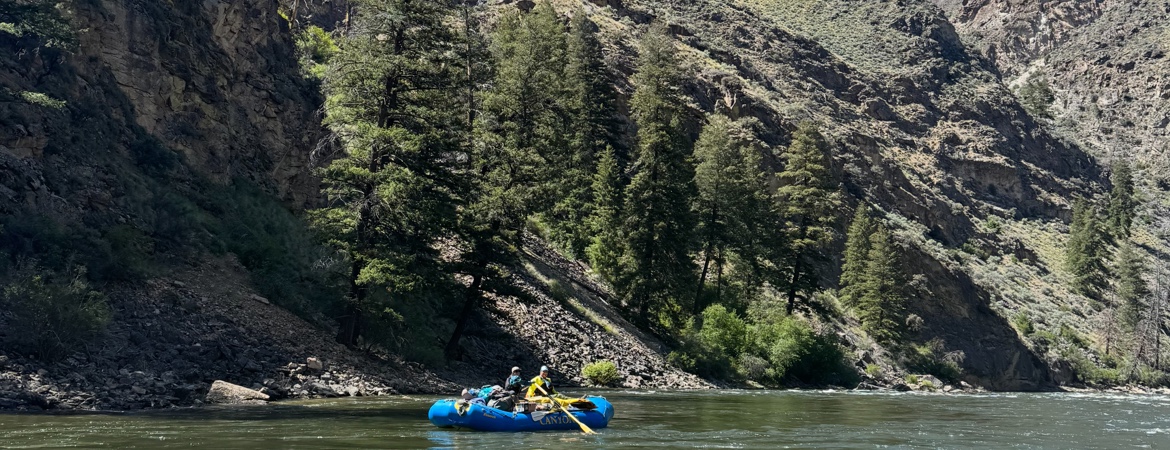
Internal Hydrology: Why You’re More Watershed Than Human
By Elle Olsztyn
 In yoga, we speak of Nadis—the thousands of invisible channels through which Prana (life force) pulses. But you don’t need a yoga mat to visualize them. If you look at a river system from an aerial view, a diagram of the Earth’s circulatory system appears. Our bodies are 60% water; our veins, nerves, and energy channels follow a similar braided cartography as a free-flowing river.
But here’s the thing: It isn’t until you spend six days on the Salmon River—feeling into the current’s rhythmic lullaby or weighted pull of the oars—that you realize you aren’t just traveling through a watershed. You are one.
As a lover of movement and the ancestral wisdom of our own physiology, I’ve been recently traveling the world exploring traditional teachings that reconnect us to our restorative nature. Through these travels, my relationship to river guiding continues to evolve. I’ve realized that the “dams” we encounter in rivers—stagnation, blockages, and rigid walls—mirror the ones we build inside our own bodies. When we understand a little about our own Internal Hydrology, we can trade “muscling” our way through life for the fluid, restorative power of the current.
The Thalweg: The Spine as the Central Channel
In hydrology, the Main Channel is the heart of the system. It’s the primary river vein that dictates the health of every tributary and eddy downstream. Within the Frank Church-River of No Return Wilderness, the Main Salmon River surges through a deep canyon. Amidst the center of that current is the Thalweg, where the water is calmest and most powerful. However, if this main channel becomes blocked, the entire ecosystem stalls.
In your body, that Main Channel is your spine—but more specifically, it is your internal Thalweg.
In the yogic tradition, this is the Sushumna Nadi. Physically, it corresponds to your central nervous system and is the primary current through which your life force flows from tailbone to crown. Just as a river guide inspects the current to find that one line of maximum efficiency and depth, we can explore such current in own bodies.
Alignment vs. Stagnation
Drawing from the work of my teacher, Simon Borg-Olivier, and his Yoga Synergy system, I’ve learned that “the banks” (our bones and alignment) determine the health of the “current” (our blood and energy).
eMost of us have become “Modern-Day Statue People”—accustomed to chairs, we either sit with lower backs cemented like a concrete dam or slump like a collapsing cutbank. But a rigid or collapsed spine is a dammed river. It creates a logjam of tension in your neck and shoulders and blocks the flow of information through your nerves. In contrast, when this channel is free-flowing, your reactions are faster, your breath slower, and your nervous system is resilient enough to navigate the big water and “Redside” rapids of life without snapping.
Micro-Ritual: Become the Watershed
On your next river trip, I invite you to explore the living ecosystem that is YOU. While sitting on the raft or in your kayak, notice the way the river’s current ungulates and swirls. When the water turns glassy, try this:
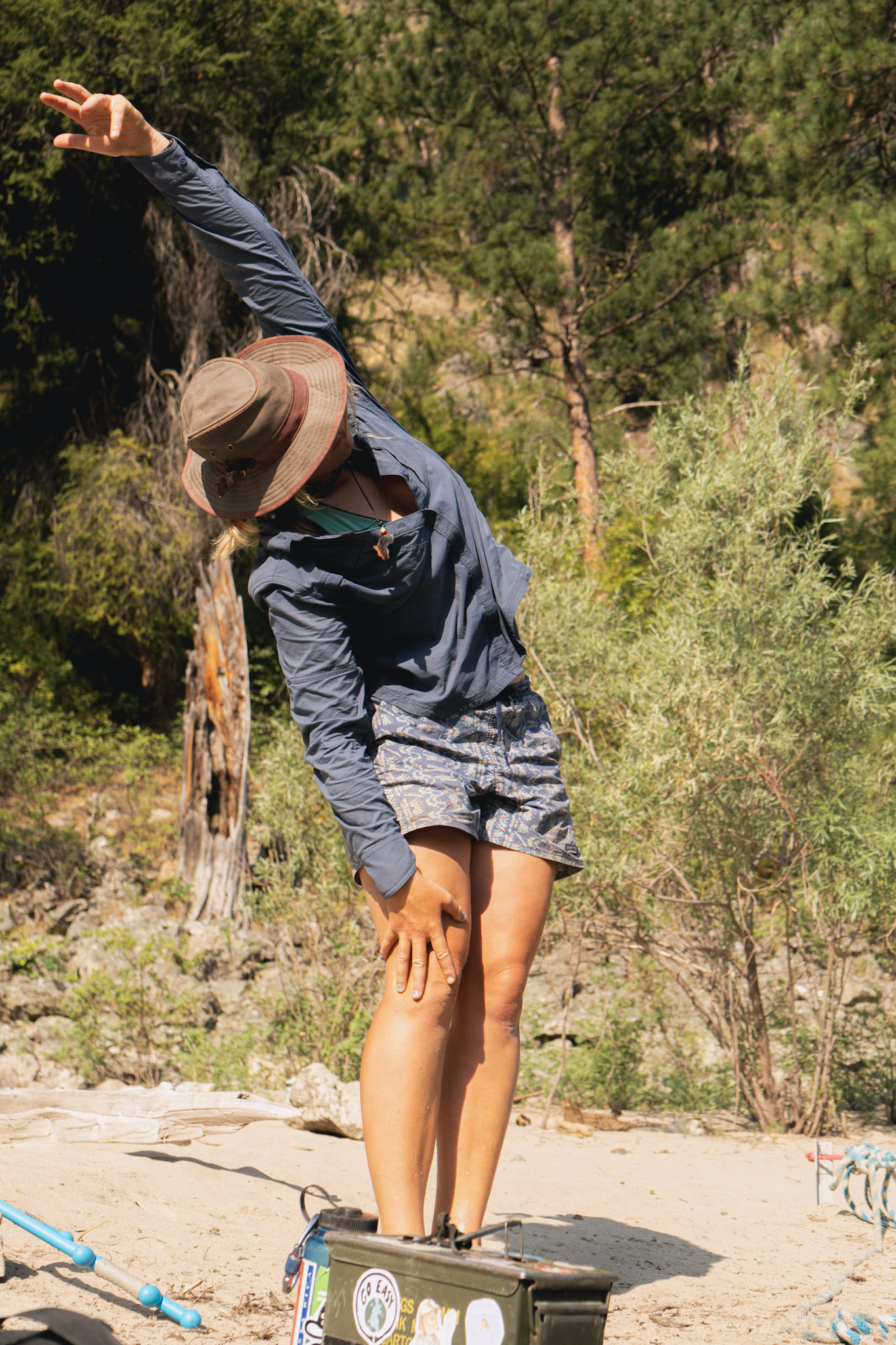
- The Spinal Ripple: Instead of sitting like a statue, imagine a gentle ripple moving from your tailbone to the crown of your head.
- The Riffle Sync: Synchronize your wiggling toes and waving fingers to the riffles in the current. Imagine the blood reaching the furthest “tributaries” of your extremities.
- Find Extension: Imagine a small wave moving through your vertebrae. Can you find a little more space? A little more extension?
By bringing this gentle consciousness to your eyes, jaw, and shoulders, we practice a state of fluid presence. This is where your body finally begins to process and flush the stress you carried with you from the outer world.
Softening your spine doesn’t mean losing your strength; it means finding the same kind of power a river has—power that comes from momentum and structure, not from being a wall.
Similar Posts by The Author:
- Off Beat Interview Series with Ensi Armacost
- Off Beat Interview Series with Jasmine
- Off Beat Interview Series with Sanne Hilbrich
- Off Beat Interview Series with Mike Hipsher
- The Interior Guide: How to Actually Show Up for Yourself this River Trip